The Lever of Balance: Building Structural Intuition with Tableware
We often treat structural engineering as a highly academic discipline reserved for university lecture halls. We teach it through complex vector diagrams, torque calculations, and stress analysis equations.
But before the math ever makes sense, an engineer must develop a physical intuition for balance.
You can build this intuition using two forks, a toothpick, and a glass.
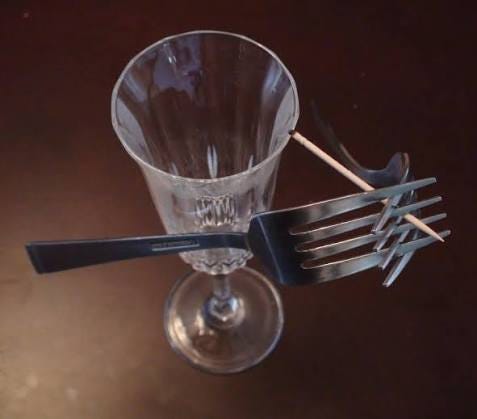
When you interlock the tines of the forks and insert the toothpick through them, you are creating a single rigid body. By sliding the toothpick along the rim of the glass, you are searching for the pivot point. Because the heavy handles of the forks curve backward, they shift the center of mass of the entire system.
The center of mass is no longer in the middle of the forks. It sits directly below the tip of the toothpick resting on the glass.
When the center of mass is below the pivot point, the system is in stable equilibrium. If you push the forks, they sway but return to the center. Gravity is working to stabilize the structure.
This is the exact same engineering principle used in skyscrapers and high-altitude cranes.
If you give a student a pre-balanced toy, they learn nothing about this relationship. But when you hand them two forks and a toothpick and let them fail ten times, they are forced to feel the shifts in weight. They must adjust the angles, observe the feedback, and find the balance point manually.
The struggle is not an obstacle to the lesson. The struggle is the lesson.