Guiding Light: How to Teach Fiber Optics Without the Black Box
We live in a world surrounded by invisible infrastructure. Every time we load a website, watch a video, or send a message, data is traveling across the globe through glass fibers thinner than a human hair.
Yet, when we teach this in school, we treat it as an abstract, mathematical formula. We write the law of refraction on the board, draw a diagram of light bouncing inside a cylinder, and tell the students to memorize the equations.
To make it more “engaging,” some schools use digital simulations. But a simulation removes the physical intuition.
You can build a physical waveguide using just a plastic bottle, water, and a laser pointer.
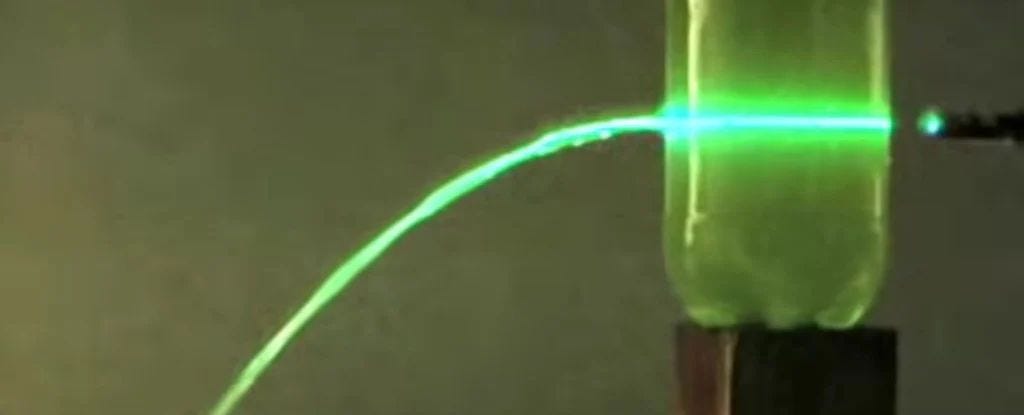
When the water pours out of the bottle in a smooth arc, the stream acts as a boundary. When the laser pointer is aimed directly at the exit hole, the light enters the water stream at an angle greater than the critical angle. Instead of passing through the water into the air, the light is reflected back into the stream. It bounces off the internal walls of the water arc over and over again, effectively trapped.
This is Total Internal Reflection.
By building this waveguide from scratch, a student learns how physical surfaces affect light. They see that if the water stream is turbulent, the light escapes. They discover that the angle of the laser must be precise.
They are dealing with the raw physics of boundaries.
When a student sees a laser beam bend along a stream of water, the concept of refraction ceases to be a memorized definition. It becomes a physical reality. We must stop hiding the mechanics of the world inside sealed plastic devices and digital simulations. We must let students build the infrastructure of the future using the raw materials of the present.