The Physics of the Crash
We have a safety problem in modern education, but it is not the kind you think.
In our effort to make classrooms orderly, we have designed science experiments that are entirely sterile. We buy plastic kits where every reaction is slow, controlled, and visual. The students watch a color change or a dial move. They write down a number. They learn the equation.
But they do not feel the physics. And because they do not feel it, they do not remember it.
Compare that to the physics of a vacuum. You can teach this using a premium, sealed bell jar. Or you can teach it by heating a tin can on a hot plate, sealing the steam inside, and plunging it into ice water.
The result of the second approach is a sudden, violent implosion. The aluminum walls buckle instantly with a sharp metallic bang.
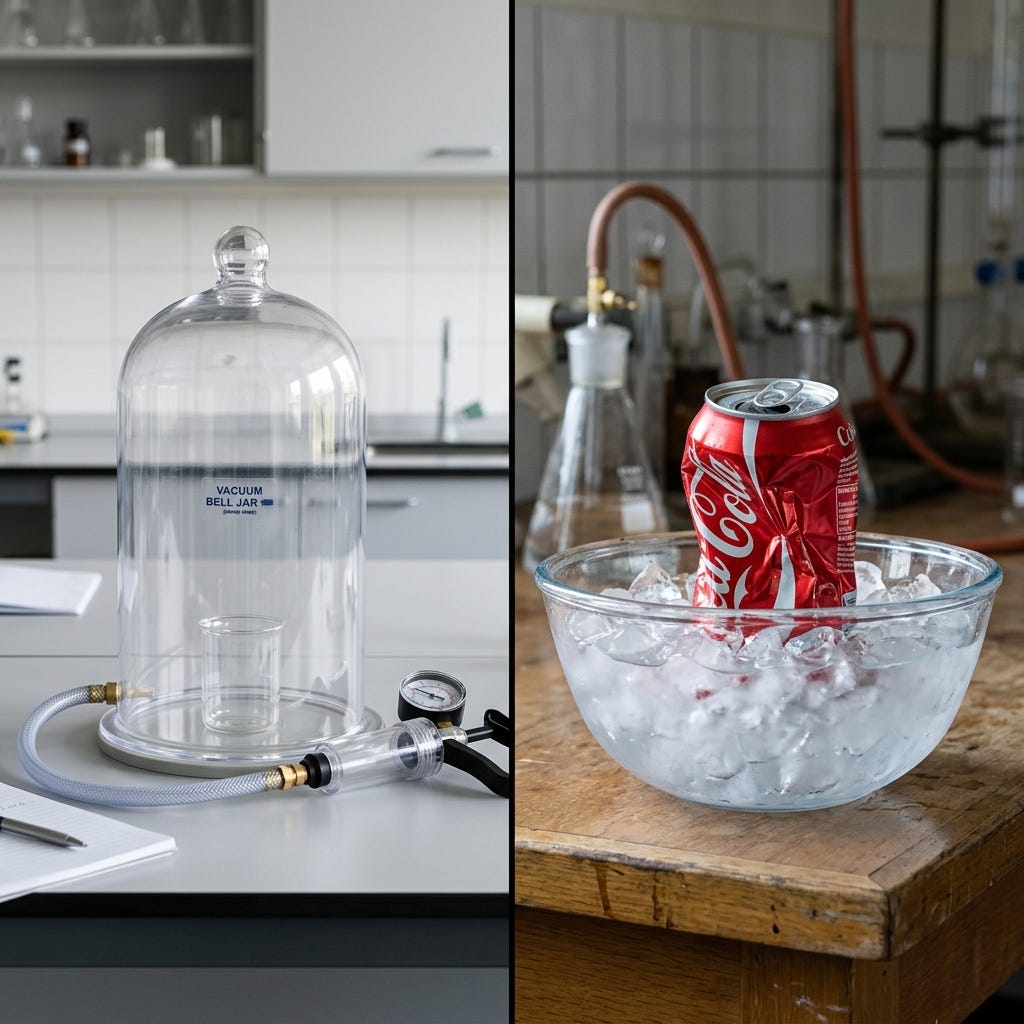
This sudden release of energy does something critical for a child’s brain: it creates a cognitive shock. When the can crushes itself, the student is forced to reconcile what they just saw with what they know about empty space. They have to think about the transition of state, how steam occupies volume, and how rapidly cooling that steam drops the internal pressure to zero.
More importantly, the experiment forces them to deal with physical realities. They have to manage the hot metal, ensure the seal is perfect, and execute the flip with precision. If their seal is weak, the experiment fails.
That failure is where the learning happens. They have to troubleshoot. They have to understand the limits of their materials.
A plastic bell jar with a hand pump has a 100% success rate because the manufacturer designed out the failure. But by designing out the failure, they also designed out the education. If we want to build students who can navigate the unpredictable, messy problems of real engineering, we must stop giving them sanitized toys. We must bring back the raw, physical resistance of the world.