The College Admissions Meta: Why Ivy Leagues Ignore “Robotics Club”
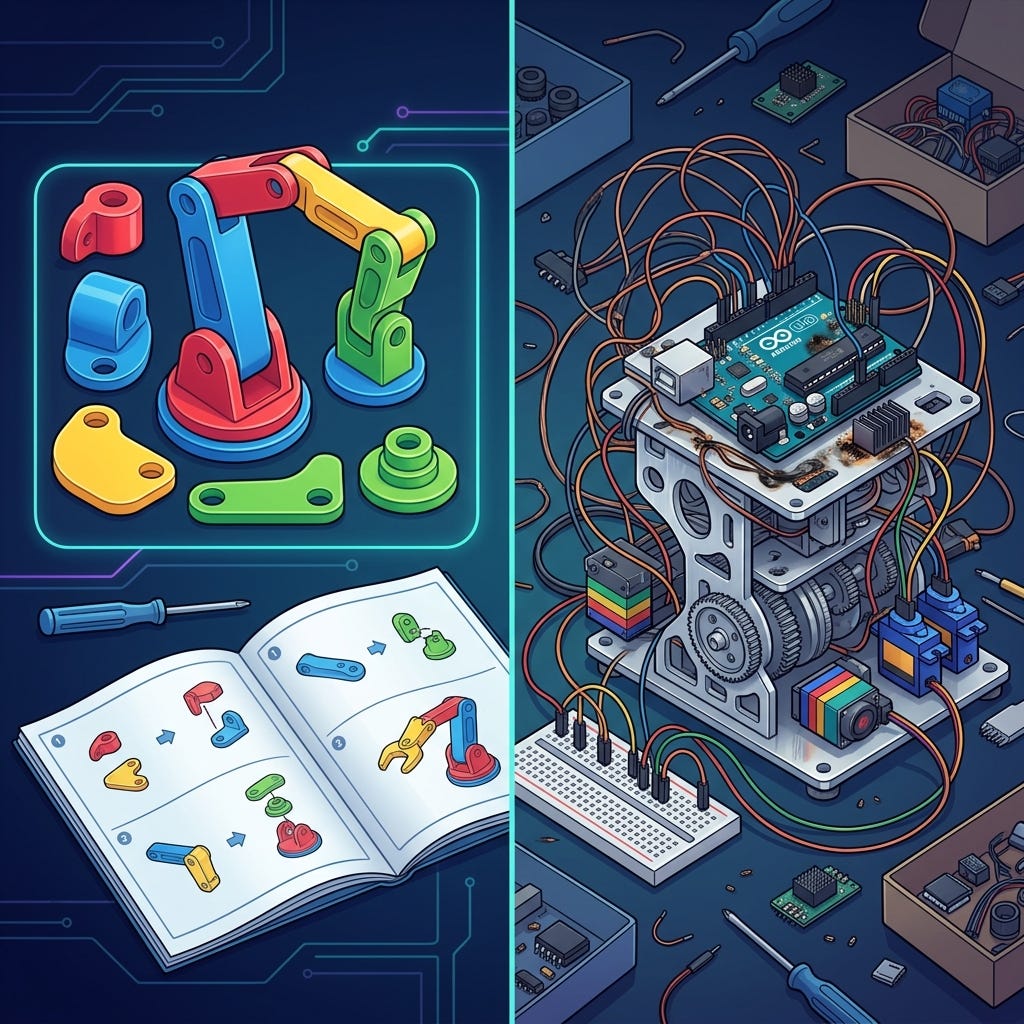
If you talk to any parent of an aspiring high school engineer today, their strategy is almost identical:
Get high grades in Physics and Math.
Join the Robotics Club or Science Olympiad.
Attend a summer STEM camp.
A decade ago, this was the blueprint for getting into MIT, Stanford, or the IITs. Today, it is the bare minimum. Every single applicant to an elite engineering program has “Robotics Club Member” on their resume. It has become a meaningless signal.
When everyone follows the same manual, how do admissions officers tell the difference between a student who is genuinely brilliant and a student whose parents simply bought them the right kits and memberships?
The “Kit” vs “Raw Material” Divide
Elite universities have caught on to the fact that modern high school STEM education has been heavily sanitized.
Most high school “Robotics Clubs” rely on expensive, pre-packaged kits (like Lego Mindstorms or VEX Robotics). These kits are designed not to fail. The pieces snap together perfectly. The code has pre-written libraries. If a student gets stuck, there is a manual to consult.
This teaches algorithmic compliance: following steps A, B, and C to get result D.
But true engineering is not algorithmic; it is heuristic. It is about navigating the messy, unpredictable friction of raw materials. When you build a motor from a battery and bare copper wire, there is no manual. When it fails, you have to troubleshoot the actual physics—is the wire too thick? Is the magnetic field misaligned? Is there too much friction?
This is exactly what MIT means when they talk about “Intellectual Vitality.” They do not want kit assemblers. They want problem solvers.
The Rise of the “Maker Portfolio”
This shift in the admissions meta is most clearly seen in MIT’s introduction of the Maker Portfolio.
The Maker Portfolio is a specialized supplement where students submit documentation (photos, code, videos, and failure logs) of physical projects they have built independently.
Here is the critical caveat most parents miss: If a project was handed to a student as a school assignment or a summer camp task, MIT does not care. Building something because you were told to build it is just another form of algorithmic compliance.
Admissions officers are looking for agency and internal motivation. They want to see a student identify a unique problem in their own life (or community), choose to solve it, and document the messy, ambitious process of building that solution from scrap.
The documentation itself is the goldmine. A student must be able to articulate:
The Catalyst: Why did you choose to build this specific thing?
The Friction: What failed during iteration 2, and how did you pivot?
The Resourcefulness: How did you overcome material or budget constraints?
A student who documents their 3-month struggle to build a self-watering plant system out of PVC pipes, a cheap Arduino, and scavenged water pumps demonstrates infinitely more engineering intuition than a student who bought a $500 kit and followed the instructions to build a walking robot in a weekend.
Productive Friction as the Ultimate Differentiator
So how do you prepare your child for this new meta?
You have to reintroduce them to Productive Friction.
Stop buying kits that guarantee success. Instead, give them raw materials—motors, batteries, wood, springs, and multimeters. Challenge them to build a self-supporting Da Vinci bridge using only popsicle sticks and friction. Ask them to build a homopolar motor using nothing but a battery and a magnet.
When they fail (and they will), do not give them a manual. Guide them through the physical principles governing their failure.
When it comes time for college applications, they won’t just list “Robotics Club” on their resume. They will have a high-fidelity physical portfolio of raw engineering projects, complete with the failure logs and iterative thinking that elite universities are desperately looking for.
That is how you beat the meta. You don’t play the same game as everyone else; you play a harder one.