Algorithms vs. Heuristics: Why Schools are Building the Wrong Operating System
When a student scores 98% on a physics exam, we assume they are prepared for the real world. We assume they are an engineer.
They are not. They are a calculator.
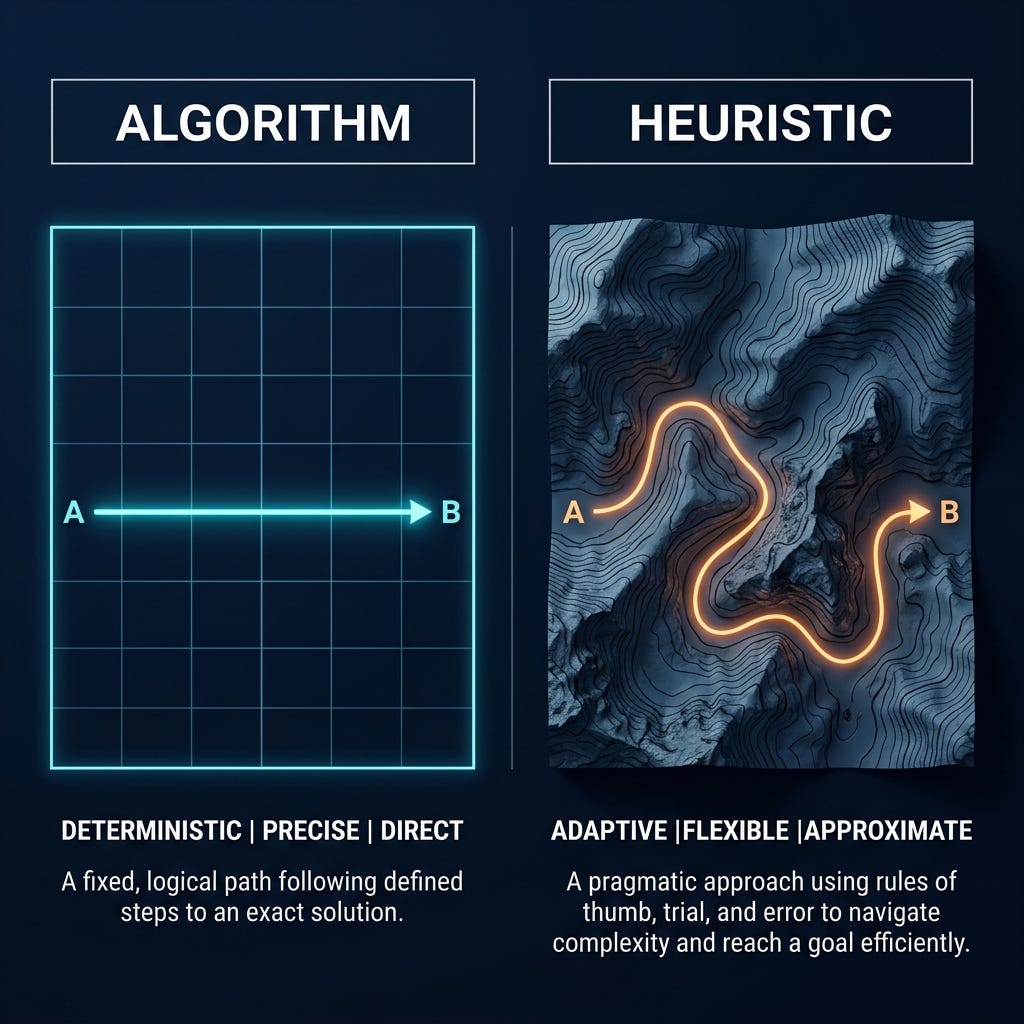
There is a fundamental disconnect between how we test intelligence and how the world demands it. Modern K-12 education is obsessed with Algorithms—step-by-step procedures guaranteed to produce a specific outcome. If you follow the formula, you get the right answer. Even for hyper-competitive entrance exams like the JEE Advanced, algorithmic memorization fails. You can do thousands of practice problems and memorize every formula, but the questions on the paper will be entirely novel. If you only know algorithms, you will fail.
The real world, however, runs on Heuristics—flexible rules of thumb, educated guesses, and creative problem-solving tactics used when there is no manual and no guaranteed outcome.
The algorithmic trap
An algorithm tells you exactly how to build a pre-designed bridge. A heuristic tells you how to build a bridge in an entirely new environment where the terrain, weather, and soil variables are completely unknown.
When we hand students expensive robotics kits with step-by-step instruction manuals, we are teaching them algorithmic compliance. They learn how to snap “Piece A” into “Slot B.” We do this across the entire education system: forcing students to “show their work” in math exactly as the teacher did, or memorizing historical dates rather than understanding geopolitical friction. This builds Crystallized Intelligence, (and is necessary, this is how patterns are registered, and old patterns help see new pattern, it doesn’t destroy CQ, it ignores its development) but it actively destroys their Creative Quotient (CQ).
When these students enter the workforce and face a novel problem with no manual, their cognitive engine redlines—they freeze up, unable to process the lack of clear instructions, and burn out trying to find a “right” formula that doesn’t exist. They have never been taught how to navigate the friction of ambiguity.
The heuristic driver (CQ)
Intelligence (IQ) is the torque of the engine—the raw, baseline power capable of doing heavy lifting. But CQ is the driver who decides how to steer that power when the road suddenly disappears.
In the clinical framework of creative thinking, the most critical metric is Resistance to Premature Closure. Algorithmic thinkers rush to the first available, safe solution. Heuristic thinkers keep the problem space open. They look at an everyday object like a standard paperclip not just as a tool to hold paper, but as a potential circuit connector, a structural pin, or a makeshift gear.
They break the mold.
The clinical-grade solution
We must stop teaching compliance and start engineering productive friction.
At Curioso, we don’t use kits. We give students raw materials—copper wire, batteries, tape—and a problem. No instructions. No right answer.
When a student fails, struggles, and eventually invents a heuristic solution, they aren’t just learning physics. They are optimizing their cognitive operating system.
Stop training calculators. Start building systematic problem solvers.