The No-Kit Manifesto
The Systematic Failure of STEM
Most modern STEM education has been “IKEA-fied.”
We have replaced the rigorous engineering struggle with pre-packaged robotics kits, frictionless manuals, and “batteries-included” sensors. In our rush to make science “fun,” we have accidentally made it superficial. We are training a generation of compliant assemblers, not systematic problem solvers.
The “Frictionless” Trap
When a student opens a science kit, every part fits perfectly. Every screw is the right size. Every sensor is pre-calibrated. There is no friction.
The Psychological Cost: This frictionless environment creates an “Illusion of Success.” A student follows a 20-step guide, builds a moving robot, and feels like a master. But if you take away the kit and give them a PET bottle, a strip of wood, and some tape, they collapse. They have mastered the manual, not the physics.
The Case for Productive Friction
At Curioso, we enforce a strict No-Kit Policy.
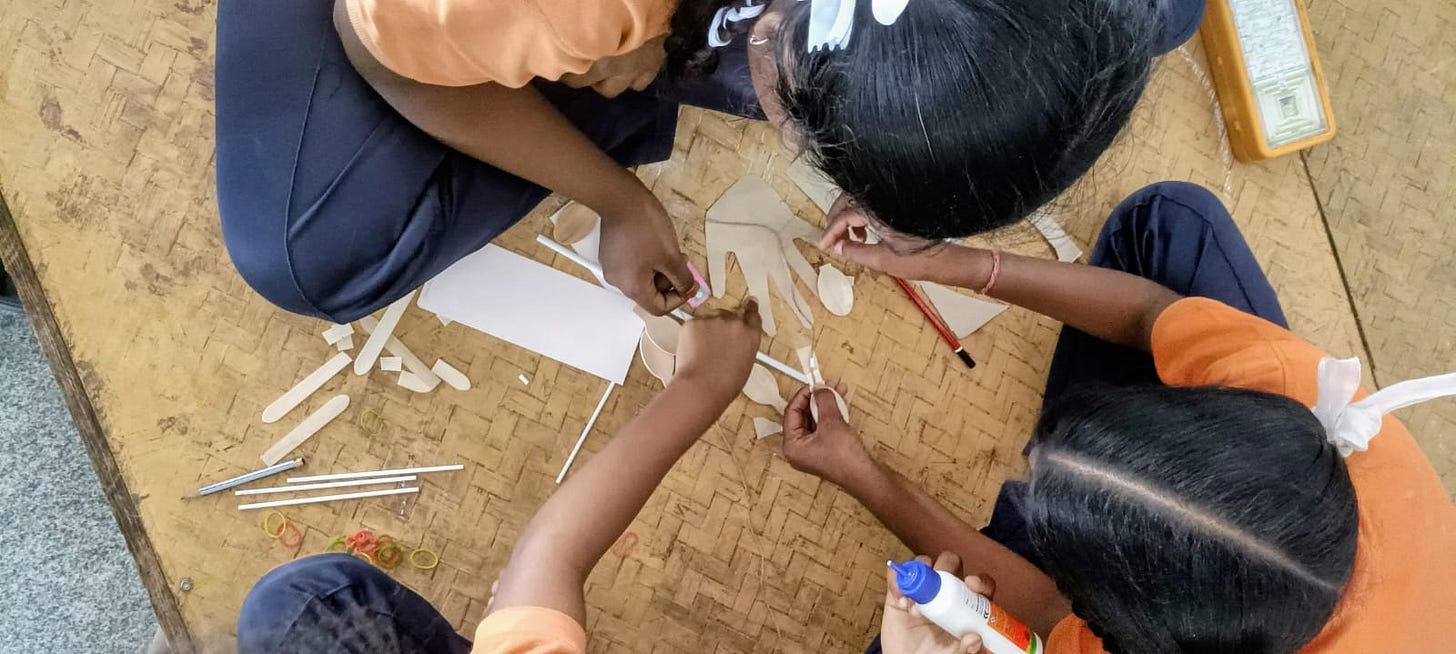
We use raw materials because they are harder. Raw materials fight back. They require an understanding of tolerances, material fatigue, and first-principles optimization.
True Agency: Learning from raw materials forces students to engage with the full design loop. They must select a material, estimate its strength, calculate tolerances, and anticipate how it will behave under load. When a wooden beam cracks or a joint loosens, the learner experiences the consequences of an inaccurate assumption and iterates the design. This iterative struggle mirrors the engineering process used in high‑stakes fields such as aerospace, civil infrastructure, and medical device development, where every component must be justified by physics rather than by a pre‑packaged kit.
Clinical Rigor: In the real-world there are no ready‑made kits; every problem is a system of interdependent parts that must be optimized from first principles. By removing kits from the classroom we replicate this rigor: students must derive the forces acting on a simple wooden wing, predict how the material will deform, and adjust their design accordingly. This discipline builds a mindset of precision and accountability that cannot be cultivated through plug‑and‑play solutions.
The “Why” over the “What”: When a student attempts to build a structure from raw wood and the construction fails, the failure itself becomes a data point. They observe how gravity pulls the piece down, how friction between joints resists motion, and how material grain influences strength. These observations lead to questions about why the structure behaved as it did, prompting deeper inquiry into physics concepts such as torque, center of mass, and material elasticity. In contrast, a perfectly fitting plastic snap‑kit delivers the end result without exposing the learner to these fundamental questions.
The Manifesto
We aren’t just teaching science; we are restoring Agency.
If we want a generation capable of colonizing Mars or solving the global energy crisis, we cannot train them on pre-packaged toys. We must return them to the struggle. We must return them to the raw material.

Jeetesh Gulani Founder, Curioso Engineered for Curiosity.